The bow of a fishing boat faces a pine island and granite point across rippled water.

A LITTLE FRIENDLY COMPETITION

Read the Lake: Ontario Fishing Game

Study the chart. Read the conditions. Decide where the first cast belongs.

ONTARIO FISHING / THE GAMEBy Due North Marketing · Updated

A point is easy to spot from the boat. Deciding whether to fish it takes more thought. Read the Lake is an Ontario fishing game built around that decision: study the lake chart, read the season and weather, then choose where you would fish.

The game uses made-up lakes, with different shapes, depths and conditions. It is a chance to practise your fishing judgement, compare choices and see what you missed. It is not a navigation chart or a forecast for real water.

Read the Lake

Study the depth chart and today's conditions, then answer one question per fish: where would you fish for it? Hover over the chart to sound the bottom, or tap to drop a pin and read what is under it.

Loading lake
Depth contour (m) Weed bed Reeds Rock and boulders Shoal near surface Creek or river

Lakes are generated, not real. Fish locations follow widely accepted seasonal patterns for Ontario lakes, but fish do not always read the textbook. Open seasons, limits and sanctuaries vary by Fisheries Management Zone, so check the Ontario fishing regulations before you head out.

Lakes are generated, not real. Fish locations follow widely accepted seasonal patterns for Ontario lakes, but fish do not always read the textbook. Open seasons, limits and sanctuaries vary by Fisheries Management Zone, so check the Ontario fishing regulations before you head out.

How to play

Read the Lake

Every round drops you on a lake you have never fished, on a random day of the open-water season. Your job is to read the chart and the conditions, then pick the one spot where you would fish for each species.

WPNSLMT
  1. 1

    Check today’s conditions

    The panel beside the chart shows the season and water temperature, time of day, sky, wind, water clarity and the thermocline. They all move fish:

    • Bright sun and clear water push fish deeper and tighter to cover. Cloud, rain, dawn, dusk and a good chop bring them shallower.
    • Wind pushes baitfish onto the downwind shore, and predators follow.
    • In summer, most fish stay above the thermocline. Lake trout are the exception and stay in the cold water below it.
    • The season matters most. Fish spawn, move to summer spots, then feed up for fall.
  2. 2

    Study the chart

    Contour lines and soundings show depth in metres. Look for points, humps, reefs, drop-offs, weed beds and edges, reeds, rock, shoals (+) and creek mouths. Hover over the chart, or tap it on a phone, to sound the bottom and read the depth, bottom type and structure under you.

    Use the + and − buttons in the corner of the chart to zoom in for a closer look, then drag to move around. You can also pinch on a phone or tablet, or hold Ctrl and scroll with a mouse. The corner-arrows button shows the whole lake again.

  3. 3

    Answer one question per fish

    The bar above the chart asks “Where would you fish for walleye?” Tap the chart to drop your pin, and the game moves to the next fish. Drag any pin to fine-tune it. The depth readout follows the pin’s tip as you drag. You can skip a fish and come back, or tap any fish to move its pin. On a keyboard, use the arrow keys and press Enter, and the + and − keys to zoom.

  4. 4

    Score your spots

    When your pins are down, press Score my spots. The results show where each fish was holding, with a glow on the chart and a star on the best water, and explain why they were there.

The rules

  • One pin per fish. Pins go on open water, not land.
  • Each fish is worth 100 points. Your pin scores the best water within a short cast of it, so the closer you are to where the fish are holding, the higher the score.
  • A skipped fish scores 0.
  • Lake trout only live in lakes deep enough to stay cold all summer, 18 m or more. Shallower lakes have six fish instead of seven, so a round is out of 600 or 700.
  • Once you score, pins are locked. Press Try this lake again to start that lake over.

Lodge legend 86% and up · Seasoned guide 70% · Local regular 50% · Weekend angler 30% · Skunked below that

Lake codes

Every lake has a six-character code, shown in the Lake code box at the top. A code always brings back the exact same lake: the same shape and depths, the same season, wind and sky, and the fish in the same spots.

  • Replay a lake. Write down the code, then type it in and press Load to try for a better score.
  • Challenge a friend. Send them your code and compare scores on the same water.
  • New lake or Fish a new lake rolls a fresh random lake with a new code.

Codes use letters and numbers, like 4K2Q7X. Capitals don’t matter.

Lakes are generated, not real. Fish locations follow widely accepted seasonal patterns for Ontario lakes, but fish do not always read the textbook. Open seasons, limits and sanctuaries vary by Fisheries Management Zone, so check the Ontario fishing regulations before you head out.

One lake. Several fishing decisions.

Pick a spot for each fish in the round. The chart shows depth and bottom features; the side panel gives the day’s conditions. Work through the fish, place your pins and score the round. The result helps you look back at the water you chose instead of only checking the total.

Play the same water again

Every lake has a code. Save it to return to the same chart and conditions, or give it to someone else for a friendly comparison. A new lake gives you another set of decisions. The game’s own How to play button explains the controls, scoring and lake codes.

Take the question to real water

On the next fishing trip, slow down before the first cast. Look at the wind, the shore and the shape of the water, then ask what you expect to find below the boat. A real lake still needs a proper chart, local advice and a check of the fishing rules. The game is practice for thinking through a choice, not a substitute for those checks.
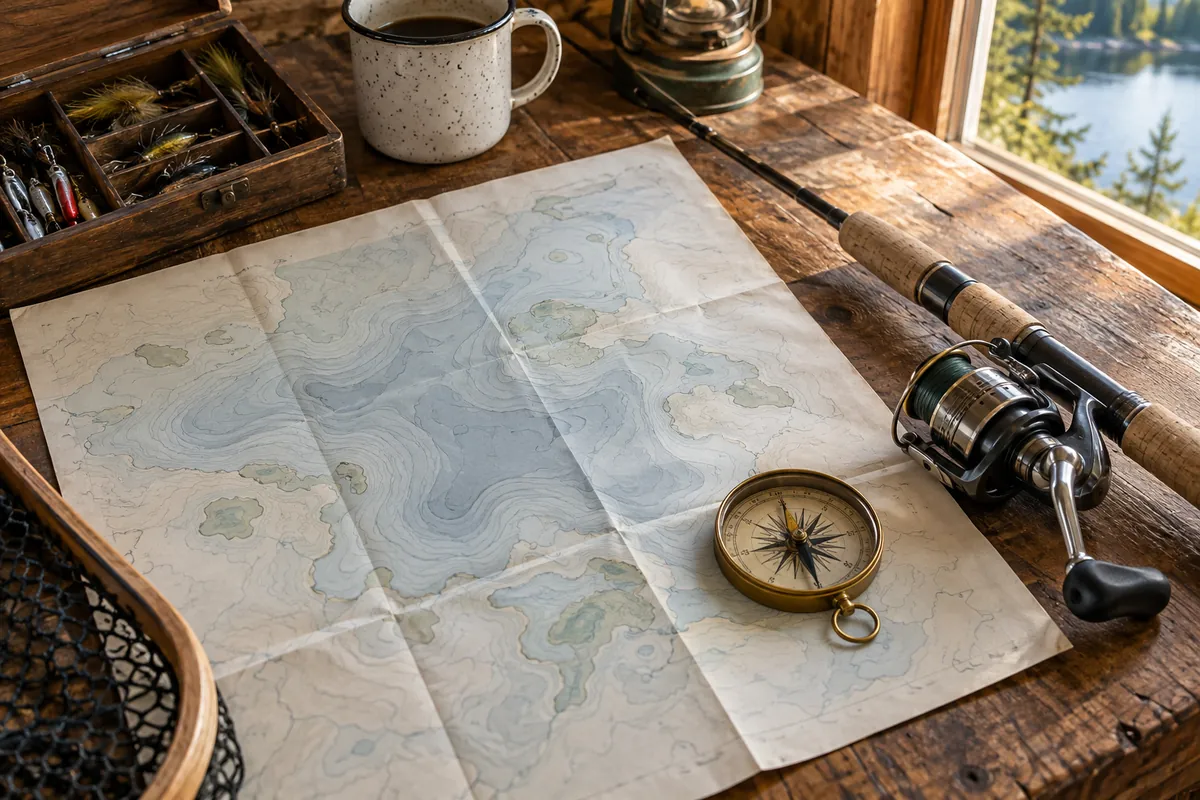
An unmarked contour sketch, compass, reel and rod grip on a wooden table.
The question starts with the chart.

KEEP READING

Make a few decisions before the drive.

Choose a region and narrow the trip to water that fits the boat, the time and the people coming along.

Where to Fish ↗